

How much does it cost to build an online store?
What an online store costs to build: the factors behind the price, Oxtren packages from €2,490, running costs to budget for, and how to get an exact quote.


In short
The cost of an online store depends on the platform, the size of the catalogue, the integrations and how much of it has to be custom. At Oxtren Labs, a store with up to 100 products set up or imported, payments and shipping starts from €2,490; a range of up to 500 products is priced on scope, and larger catalogues individually. On top of the build, budget for hosting, payment fees, licences and maintenance after launch.
Key takeaways
- The price is driven mostly by catalogue size, integrations and custom features – not by the number of pages.
- An Oxtren Labs online store starts from €2,490: up to 100 products set up or imported, payments and shipping.
- The build is not the whole bill: hosting, payment fees, licences and maintenance recur monthly or yearly.
- Before the first call, note your product count, the payment and shipping options you need, and the systems the store must exchange data with.
- Get the exact price, scope and timeline in writing before work starts – it leaves nothing to argue about later.
Why there is no single price
A shop with 60 products and one payment provider and a shop with a few thousand products, a warehouse system and several countries are different projects, even if we use the same word for both. So this article starts with what the price is made of, then shows our packages and the costs that appear after launch, and ends with what to prepare so the quote is accurate the first time.
If your store is already live but sells less than you expected, a new store is not always the answer. Start with the most common mistakes that cost online stores sales, or ask for a free purchase-path assessment – it shows what to fix in the store you already have.
What drives the cost of an online store
The price is hours of work, and a handful of clearly identifiable things decide how many. The sooner you know them, the more accurate your quote.
Platform
For a standard store, WooCommerce – an open-source ecommerce plugin for WordPress – is usually enough. If you would rather have hosting included in a monthly platform subscription, Shopify is the usual choice – we build and maintain Shopify stores too. We compare the two on cost and day-to-day management in Shopify vs WooCommerce. When the catalogue is large, the processes are unusual, or speed and design freedom matter most, a headless or fully custom build makes more sense. It costs more because more of it is built specifically for you.
- Headless online store
- A store where the part shoppers see (the website) is separated from the ecommerce system that manages products, the cart and orders. The two exchange data through an API, which gives more design freedom but takes more development.
Catalogue size and product setup
100 and 1,000 products differ by more than a number. A larger catalogue needs well-planned categories, filters, variants (sizes, colours) and an import from existing files or systems. If your product data lives in several spreadsheets today, cleaning it up can take longer than the import itself.
Integrations
Every store has payments and shipping. What adds cost is what sits behind them: accounting software, a warehouse or ERP system, a CRM, an email marketing tool, product feeds for comparison sites. Each integration means mapping data, handling errors and testing. When orders need to reach your CRM or invoicing system without anyone copying them across, some of those connections can also be handled with process automation.

Custom features
Product configurators, customer-specific wholesale pricing, subscriptions, bookings or complex discount rules often need development that no off-the-shelf plugin covers. These are estimated separately.
Design and content
An adapted theme and a custom design cost different amounts. Content is work too: product descriptions, photos, delivery and returns terms, FAQs. Before you sign, check who prepares the content – you or the developer.
SEO and maintenance
Basic SEO at launch and ongoing SEO are different things. The first makes sure search engines can find and understand the store. The second is monthly work on content and technical health. Maintenance after launch – updates, backups, monitoring – is also a separate, recurring cost.
What an online store costs at Oxtren Labs
Our online store development packages differ mainly by catalogue size. Prices are “from” prices and final – VAT is not applicable. If an offer is running, its price is shown on the service page.
| Package | Price | Products | Included |
|---|---|---|---|
| Start | from €2,490 | Up to 100 products set up / imported | Payments and shipping |
| Business | Based on scope | Up to 500 products | Payments and shipping |
| Larger catalogues | Individually | Per project | Custom commerce, headless WooCommerce or another solution as needed |
For standard stores we mostly use WooCommerce, Shopify when a hosted platform suits you better, and for larger ones a custom solution, headless WooCommerce or another solution as needed. We integrate the most popular payment and delivery providers based on your business needs.
What the price includes
- Up to 100 products set up or imported (Start) – the store doesn't open empty
- Payment and shipping integrations
- Content management (CMS) – you manage products, prices and orders yourself
- Up to 60 minutes of remote training and a short guide
- Analytics, basic SEO and a speed check at launch
- A 6-month warranty: we fix bugs in what we built and delivered
- Domains, business accounts and accounts created in your name belong to you
Running costs to budget for
Below are the costs that come with or after launch. Some depend not on the developer but on the providers you choose.
| Cost | When it occurs | How to plan for it |
|---|---|---|
| Hosting and domain | Monthly or yearly | Size it to your store and traffic; register the domain in your own name |
| Payment fees | On every transaction | Compare providers against the cards and countries your customers pay from |
| Platform subscription | Monthly – if you choose a SaaS platform | Check the plan and any fees for third-party payment providers |
| Plugin, extension and theme licences | Usually yearly | Ask for a list of paid licences in the proposal |
| Courier contracts | By shipment volume | Sign with couriers before the integration |
| Content: photos, descriptions, translations | Before launch and as the catalogue grows | Agree clearly who prepares it |
| Maintenance and SEO | Monthly | Plan for it from launch or from the end of the warranty |
Payment fees
Payment providers usually charge a percentage plus a fixed amount per transaction, and the rate depends on the card type and country. Stripe, for example, lists these standard rates for Lithuania:
1.5% + €0.25
Stripe's standard rate for standard EEA cards in Lithuania; international cards are 3.15% + €0.25, plus 2% if currency conversion is required.
Source: Stripe, 20261
To put that in numbers: 200 orders a month at €50 each (€10,000), all paid with standard EEA cards, would cost about €200 a month at this rate – €150 in percentage fees and €50 in fixed fees. This is not a recommendation of a particular provider – just an example of how fees are calculated. Compare several providers based on the cards your customers use and the countries they buy from.
Platform subscription or hosting
The WooCommerce plugin itself is free – its makers describe it as an open-source platform with no monthly platform fees. It does need a server that meets its technical requirements (PHP, MySQL or MariaDB, HTTPS), so you pay for hosting. On SaaS platforms such as Shopify, hosting is part of the monthly subscription.
€27/month
Shopify's Basic plan billed monthly (€19/month billed yearly). Grow is €74/month and Advanced €384/month. Prices vary by region and may change.
Source: Shopify, 20262
Maintenance after launch
A store is not a static website: plugins change, payment provider APIs change, security patches keep coming. Every project we deliver has a 6-month warranty, but updates, backups and monitoring are maintenance work. Our website and store maintenance plans: Essential – €149/mo (up to 1 hour of work, response within 2 business days), Business – €299/mo (up to 3 hours, response within 1 business day), Priority – €599/mo (up to 6 hours, response to critical incidents within 4 business hours). Response time is not resolution time.
If the store needs steady search traffic, our SEO service plans start from €590/mo. SEO is an ongoing process, not a one-off job.
How the price changes: three situations
These are illustrative scenarios, not actual clients. They show how the same factors move a project from one package to another.
- A ceramics studio with 70 products, one payment provider and two delivery options. This fits Start: products are set up or imported, payments and shipping are integrated, and you run the store yourself.
- A clothing store with 350 products, each with size and colour variants, sending invoices to accounting software. This is Business – priced on scope, because the variant structure and the integration take most of the time.
- A wholesaler with several thousand products, a warehouse system and separate prices for business customers. A standard setup is often no longer enough – headless WooCommerce or a custom build is considered, priced individually.
Methodology
- Date
- Criteria
- Oxtren package prices and limits – from our public service pages (prices before the promotion)
- Platform and payment costs – from the public Stripe, Shopify and WooCommerce pages
- The scenarios are illustrative, built from the same factors, not real clients
- Limitations
- The final price is only in a written proposal after the scope is assessed. Third-party prices depend on the plan and may change.
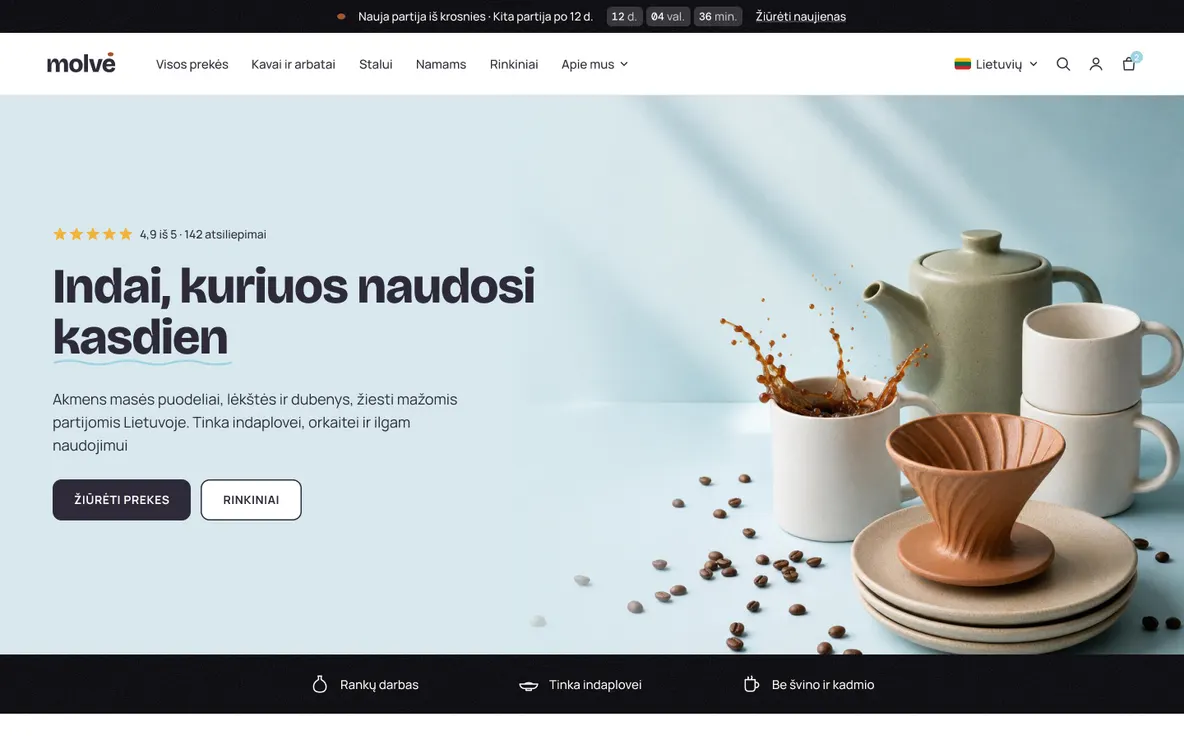
For a sense of a store from catalogue to checkout, see our Molvė concept – a handmade ceramics store for a fictional brand. It is a concept, not client work.
How to get an accurate quote
An accurate quote starts with an accurate question. You don't need a technical brief – a few sentences in your own words are enough. But the more of the points below you know, the less guesswork ends up in the price.
What to prepare before the call
- How many products at launch, and how many in a year
- Whether products have variants (sizes, colours, bundles)
- Where your product data lives now: a spreadsheet, warehouse software, another store
- Which payment methods and couriers you want to offer
- Which systems the store must exchange data with (accounting, CRM, warehouse)
- The languages and countries you will sell in
- Who will prepare the content: photos, descriptions, terms
- Your preferred launch date and budget range
Once you have the answers, tell us about your store. From there we work in four stages: conversation, proposal, build and launch. The proposal gives you the scope, a task list, the price and the timeline – in writing, before any work starts. Payment is split in two: a 50% deposit when work begins and 50% on handover. We reply to enquiries within 1 business day.
Frequently asked questions
How long does it take to build an online store?
It depends on the catalogue size, the integrations and how custom the design is. We put the exact timeline in the proposal together with the price and scope, so you know it before work starts.
Can I start with a smaller store and grow later?
Yes. You manage products, prices and orders in the admin yourself, so you can grow the catalogue without us. New features or integrations are new work: we estimate and agree them upfront.
Do your prices include VAT?
Our prices are final – VAT is not applicable. Third-party services (hosting, licences, payment providers) come with their own rates and taxes.
Who will own the store?
Once the project is paid in full, you receive the rights to the content, data and the custom code specified in the contract that were created for your project. Third-party software is subject to its own licence terms. Domains, business accounts and accounts created in your name belong to you.
Is maintenance included in the price?
The price includes a 6-month warranty – we fix bugs in what we built and delivered. Ongoing maintenance (updates, backups, monitoring and a monthly report) is a separate plan from €149/mo. It is optional: you can also order work as and when you need it.
Sources and methodology
- StripeStripe pricing (Lithuania)accessed
- ShopifyShopify pricingaccessed
- WooCommerceWooCommerce – the open-source ecommerce platformaccessed
- WooCommerceServer recommendations for hosting WooCommerceaccessed